
Open Science November
Sharing scientific knowledge, research steps and results, or educational materials - Open Science encompasses many measures and practices to make knowledge and data accessible to everyone.
Our formats:
- (Short) Introductions
- Coffee Lectures
- Workshops
- Impulse
- Expert Insights
- Networking Meetings
Target group:
Researchers, teachers and students of Ruhr University, partners of the European UNIC university network and interested parties are invited to participate in our Open Science November. This Month offers various formats - both for beginners and experts interested in the topic of Open Science.
Open Science November
Below you will find the program for the Open Science November 2026:
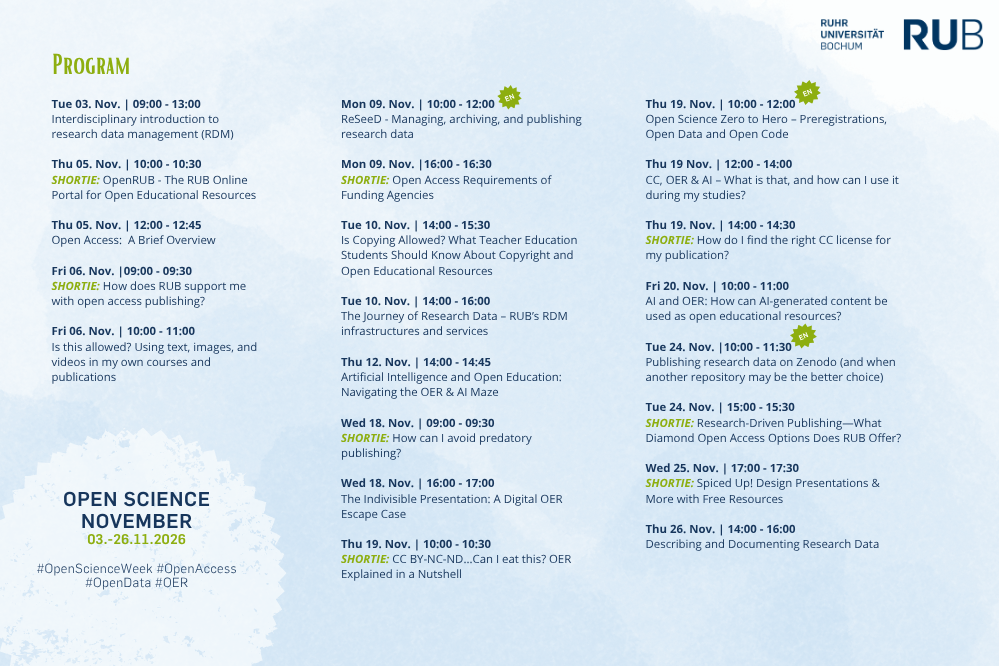

November 3, 9:00 a.m.–1:00 p.m. | Interdisciplinary Introduction to Research Data Management (RDM) (German)
Speakers: Elena Schick & Tuba Güden-Silber | Research Data Services, RUB
Target audience: Doctoral students, postdocs, professors, research administrators, staff at support services, newcomers
Location: Online
Research data forms the foundation of scientific progress and is essential for publications. In your day-to-day research, you have likely experienced situations where important data for your publication suddenly could not be found, existed in multiple versions, or was even accidentally overwritten. Avoiding such situations is one of many aspects of structured research data management (RDM). A well-organized RDM system helps you (significantly) ensure the long-term preservation of your work. In this course, you will learn
- what RDM is and why it is helpful for your scientific work.
- to understand the FAIR principles (Findable, Accessible, Interoperable, Reusable) and how to apply them in practice.
- how to efficiently structure, organize, and manage your research data.
- how to work collaboratively with multiple project partners on research data.
- which tools make it easier for you to handle research data in your day-to-day work.
Nov. 5, 10:00–10:30 a.m. | SHORTIE: OpenRUB - The RUB Online Portal for Open Educational Resources (German)
Speaker: Kathrin Braungardt | ZfW, RUB
Target audience: Doctoral students, postdocs, professors, research administrators, staff at support services, newcomers
Location: Online
OpenRUB offers you a university-specific platform for freely accessible and open teaching and learning materials for all departments at Ruhr University. Whether it’s lesson plans, presentation slides, videos, or entire Moodle courses. On this platform, you have the opportunity to openly share your educational materials with others, gain inspiration for your teaching, and showcase your teaching concepts to a wider audience.
Nov. 5, 12:00–12:45 p.m. | Open Access: A Brief Overview (German)
Speaker: Carla Hansmann | UB Bochum
Target audience: Doctoral students, postdocs, professors, research administrators, staff at support services, newcomers
Location: Online
Open Access is a central aspect of Open Science and refers to free, unrestricted, and irrevocable access to reusable scientific publications on the Internet. This event offers you an up-to-date and practical introduction to the topic of Open Access: Why is Open Access important, and what advantages does it offer? What options are available for publishing in Open Access? What should you pay particular attention to, and what funding opportunities are available to you?
Nov. 6, 9:00–9:30 a.m. | SHORTIE: How does RUB support me with open access publishing? (German)
Speaker: Carla Hansmann | UB Bochum
Target audience: Doctoral students, postdocs, professors, research administrators, staff at support services, beginners & advanced users
Location: Online
Would you like to publish in Open Access? We’ll introduce you to the Open Access services at RUB and answer your questions: How do I apply for funding from the publication funds? Which publisher agreements can I benefit from? What should I keep in mind in the context of Project DEAL (Wiley, Springer, Elsevier)? What other publication services does the University Library offer?
Nov. 6, 10:00–11:00 a.m. | Is this allowed? Using texts, images, and videos in your own courses and publications (German)
Speaker: Kathrin Braungardt | ZfW, RUB
Target Audience: Doctoral students, postdocs, professors, research administrators, staff at support services, newcomers
Location: Online
What am I allowed to do when using images and videos for my own teaching materials and publications? What copyright guidelines must be followed? In this brief introduction, you’ll find answers to these questions and gain an overview of the copyright issues relevant to the university, using specific case studies.
Nov. 9, 9:00 a.m.–1:00 p.m. | ReSeeD - Managing, archiving and publishing Research Data (English)
Speakers: Willem Fiene & Marlene Pacharra | Research Data Services, RUB
Target audience: Doctoral students, postdocs, professors, beginners, and advanced learners
Location: Online
ReSeeD, the central research data repository of Ruhr University Bochum, offers a comprehensive infrastructure for research data management. The repository covers various use cases (e.g. metadata assignment, role and rights management, collaborative work) and is suitable for different types of data.
In this workshop, you will explore
- the basic functionalities of ReSeeD.
- how to manage and store your data in ReSeeD - from the creation of datasets, collaboration and sharing of datasets, to their archiving and publication.
- You will gain hands-on experience with ReSeeD, allowing you to directly apply what you've learned.
Participants without a RUB-LoginID can get access to ReSeeD via a free ORCID-iD.
Nov. 9, 4:00–4:30 p.m. | SHORTIE: Open Access Requirements of Funding Agencies (German)
Speakers: Carla Hansmann & Kathrin Lucht-Roussel | UB Bochum
Target audience: Doctoral students, postdocs, professors, research administrators, staff at support services, beginners & advanced users
Location: Online
Funding agencies such as the DFG, the BMBF, and the EU have firmly established Open Access in their funding guidelines. Questions such as: - What Open Access requirements do the various funding organizations have, and what options do they offer? - How much do Open Access publications cost, and can the costs be reimbursed? - How do you publish correctly under the European Horizon Europe framework program? will be addressed in this workshop. The workshop is aimed at all researchers interested in the Open Access guidelines of third-party funding agencies, regardless of whether they are already involved in a funded project or not.
November 10, 2:00–3:30 p.m. | Is Copying Allowed? What Teacher Education Students Should Know About Copyright and Open Educational Resources (German)
Speakers: Katharina Wesphal, Joana Kadir and Lucien Kamper | PSE, RUB
Target audience: Student teachers, beginners
Location: Online
Quickly downloading an image from the Internet, scanning a page from a textbook, or copying a worksheet from another source—is that actually allowed? In this workshop, we’ll clarify what teacher education students need to keep in mind regarding teaching materials and where they can find materials that they’re legally permitted to use, edit, and share.
November 10, 2:00–4:00 p.m. | The journey of Research Data—RUB’s RDM infrastructures and services (German)
Speaker: Marlene Pacharra | Research Data Services, RUB
Target audience: Doctoral students, postdocs, professors, beginners
Location: Online
Whether you’re at the start of a project, in the middle of data collection, or about to publish—questions arise at every stage of the research data lifecycle: How do I plan my data management in a legally compliant manner? Where do I store and secure my data? How do I prepare it for reuse, and where do I publish it so it’s visible and citable?
In this event, we will present Ruhr University’s infrastructure and services across the entire research data lifecycle—from planning through collection, processing, and storage to archiving and publication. You’ll learn what advisory services, tools, and systems are available to you, how to integrate them into your daily research routine, and where to get personalized support if needed.
A practical overview for anyone who wants to manage their research data in a structured way and meet the requirements for good data management—whether you’re new to research or an experienced researcher.
Nov. 12, 2:00–2:45 p.m. | Artificial Intelligence and Open Education: Navigating the OER and AI Maze - An Overview of Current Developments—with a Focus on Community, Open Educational Practices, and Cultural Change (German)
Speaker: Daniel Diekmann | ORCA.nrw
Target audience: Postdocs, professors, research administrators, staff at support services, beginners and advanced users
Location: Online
Artificial intelligence is currently transforming the way educational content is created, used, and developed. This is also giving rise to numerous new questions, opportunities, and challenges at the intersection of artificial intelligence and Open Educational Resources (OER). This presentation provides an overview of key areas of discussion at the intersection of AI and OER—ranging from opportunities and potential to challenges and risks, as well as issues related to law, openness, governance, infrastructure, and guidance.
A particular focus is on how AI can transform open educational practices and the culture of sharing and collaboratively developing knowledge. What role do communities and Open Educational Practices (OEP) play in an educational landscape increasingly shaped by AI? And what forms of openness, collaboration, and collective knowledge production do we want to shape in the future?
The presentation invites participants to examine the complex relationship between AI and open education from various perspectives and to find their way through the growing “OER & AI thicket.”
Nov. 18, 9:00–9:30 a.m. | SHORTIE: How can I avoid predatory publishing? (German)
Speaker: Linda Groß | UB Bochum
Target audience: Doctoral students, postdocs, professors, research administrators, staff at support services, beginners & advanced users
Location: Online
It’s important for you to make your research visible and publish your findings. Some unscrupulous providers try to exploit this with fraudulent publication offers, but how can you identify them? In this session, you’ll receive helpful tips on how to recognize a potential predatory publisher.
Nov. 18, 4:00–5:00 p.m. | The Indivisible Presentation: A Digital OER Escape Case (German)
Speaker: Daniel Diekmann | ORCA.nrw
Target audience: Postdocs, professors, research administrators, staff at support services, newcomers
Location: Online
A teacher wants to share a successful presentation with others outside the protected Moodle course. But the upload is rejected: missing sources, unattributed images, incompatible licenses, and a non-editable format turn the presentation into an “unshareable presentation.” Working in small teams, participants will investigate the issue and collaboratively solve several challenges. Step by step, they will identify problematic materials, find suitable open alternatives, clarify licensing issues, and prepare the presentation so that it can actually be shared and reused.
This is not just about turning a presentation into an Open Educational Resource (OER). Educators face these challenges whenever materials leave the protected classroom environment and are to be shared, published, or reused by others. In their search for solutions, participants will learn, among other things, how to find suitable open materials on ORCA.nrw and other relevant sources, and where to find guidance on questions regarding Creative Commons licenses and the reuse of teaching materials. Will the teams succeed in solving all four problems in time and publishing their presentation?
Nov. 19, 10:00–10:30 a.m. | SHORTIE: CC BY-NC-ND...Can I eat this? OER Explained in a Nutshell (German)
Speakers: Kathrin Braungardt & Sarah Görlich | ZfW, RUB
Target Audience: Doctoral students, postdocs Professors, research administrators, staff at support services, newcomers
Location: Online
What are Open Educational Resources, and what do these Creative Commons licenses mean? In our short session, we’ll explain what OER are all about and how they can be used. So grab a cup of coffee or tea and use your break to learn the basics about using open educational resources in a quick and concise way.
Nov. 19, 10:00 a.m.–12:00 p.m. | Open Science Zero to Hero – Preregistrations, Open Data, and Open Code (English)
Speaker: Marlene Pacharra | Research Data Services, RUB
Target audience: Doctoral students, postdocs, professors, research administrators, staff at service units, beginners
Location: Online
Are you interested in integrating Open Science into your research but don't know where or how to start? This workshop is designed for researchers at all career stages who want to maximize the validity, credibility, and impact of their research through Open Science practices. You will gain hands-on experience with practices that make scientific research more transparent and reproducible, focusing on:
- Preregistrations: Understand the added value of preregistrations, learn how to easily create one on the most suitable platform, and publish it to your advantage.
- Open Software: Discover best practices for developing and sharing open-source software, with practical guidance on using GitLab.
- Open Data and Materials: Learn where and how to effectively publish your research data and materials, including strategies for finding discipline-specific repositories.
The aim of this course is to help you identify your optimal entry points into Open Science and to equip you with the tools and knowledge needed to take your first steps in implementing Open Science in your research.
Nov. 19, 12:00–2:00 p.m. | CC, OER & AI – What is that and how can I use it during my studies? (German)
Speakers: Niklas Brauer & Sarah Görlich | ZfW (eTeam Digi), RUB
Target audience: Students, beginners
Location: Online
Free learning materials, known as Open Educational Resources (OER), can enrich your studies. Whether you’re delving deeper into a topic, preparing for exams, or conducting research for presentations and other projects—OER can be a valuable source of knowledge for you. In this session, we’ll show you what CC licenses are all about, where to find OER, and under what conditions you’re allowed to use them. We’ll also provide a brief overview of the use and application of AI-generated works.
Nov. 19, 2:00–2:30 p.m. | SHORTIE: How can I find the right CC license for my publication? (German)
Speaker: Yvonne Schlootz | UB Bochum
Target audience: Doctoral students, postdocs, professors, research administrators, staff at support services, beginners and advanced users
Location: Online
Open Access and Creative Commons licenses (CC licenses for short) go hand in hand. However, choosing the right license variant for your own publication can be challenging and should be carefully considered. In this session, we’ll introduce you to the different license types and provide guidance to help you select the appropriate CC license.
Nov. 20, 10:00–11:00 a.m. | AI and OER: How Can AI-generated content be used as open educational resources? (German)
Speaker: Kathrin Braungardt | ZfW, RUB
Target audience: Doctoral students, postdocs, professors, research administrators, staff at support services, newcomers
Location: Online
AI-generated content can also be used to create open educational resources (OER) and promote them. We’ll look at examples and scenarios to explore how and in what ways this is possible and useful. For example, AI tools can be used to illustrate content, but also to adapt existing OERs for one’s own purposes. We’ll also discuss the implications of using AI-generated content for licensing.
Nov. 24, 10:00–11:30 a.m. | Publishing research data on Zenodo (and when another repository may be the better choice) (English)
Speakers: Elena Schick & Marlene Pacharra | Research Data Service, RUB
Target audience: Doctoral students, postdocs, professors, beginners, and advanced users
Location: Online
Openly sharing your research data enhances visibility, increases impact, and supports reproducibility — but where you publish it matters. This workshop introduces Zenodo as a flexible, user-friendly platform for publishing a wide range of research outputs. You'll learn how to upload data, assign DOIs, and connect your work to the RUB Zenodo Community.
We’ll also explore when other options may be more appropriate — such as discipline-specific repositories for greater peer recognition, or RUB’s institutional repository ReSeeD for large datasets requiring in-house support. Whether you're new to data publishing or just looking to sharpen your strategy, this session will help you make informed, FAIR-aligned choices.
Nov. 24, 3:00-3:30 p.m. | SHORTIE: Diamond Open Access (German)
Speaker: Yvonne Schlootz | UB Bochum
Target audience: Doctoral students, postdocs, professors, research administrators, staff at support services, beginners and advanced users
Location: Online
Diamond Open Access (DOA) refers to research-driven publishing with no fees for authors or readers. Unlike other open-access models, both publication and access are free of charge. This model is becoming increasingly important for researchers, as it enables greater visibility, wider accessibility, and fair participation in the publication process. This event offers a practical introduction to DOA and highlights the advantages of this publication model. What opportunities does it present for visibility and equal opportunity? What criteria are important when selecting suitable journals? And what support services are available for publishing in Diamond Open Access (at RUB)?
Nov. 25, 5:00–5:30 p.m. | SHORTIE: A Fresh Look! Desig Presentations & More with Free Resources (German)
Speaker: Niklas Brauer | ZfW (eTeam Digi), RUB
Target audience: Students, beginners
Location: Online
Do you need images or icons for your presentation, or are you looking for a suitable video for your talk? Would you also appreciate some suggestions on how to structure and design your presentation? We’ll show you where to find free resources for inspiration and how to use them for your presentations and other projects without worrying about copyright. And we’ll cover it all quickly and concisely during your coffee break!
Nov. 26, 2:00–4:00 p.m. | Describing and Documenting Research Data (German)
Speakers: Tuba Güden-Silber & Elena Schick | Research Data Service, RUB
Target audience: Doctoral students, postdocs, professors, advanced users
Location: Online
You’ve finally been awarded the long-awaited grant, and you can now reuse the research data you collected two years ago for your new research project and continue your work. But you no longer remember what those abbreviations stand for? What do the number combinations describing the columns in the data table mean? What parameters or settings did you use for the measurements? Through the structured and (pre)planned use of metadata and well-organized documentation, you can (largely) avoid the situation described above.
You’ll get details and practical tips on metadata and documentation in this 2-hour online workshop. You’ll learn: - what metadata actually is and where to find metadata schemas relevant to your field. - what types of documentation exist. - why it pays off in the long run to invest time in structured documentation.
About the Open Science November
The Open Science November takes place once a year at Ruhr University Bochum: Get information on Open Access, Open Data and Open Educational Resources and learn how to publish your publication as Open Access and share your research data or teaching materials with the community. Take the opportunity to discuss current developments and challenges in the Open Science community with experts and network with other Open Science enthusiasts.
You can find more information on the topic of Open Science in our open Moodle Course.

Contact
The Open Science November is organized by the Open Science Working Group of Ruhr University Bochum. If you have any questions about the event, please contact: arbeitsgruppe-openscience@ruhr-uni-bochum.de